
Rosemary oil for hair: grow and strengthen naturally


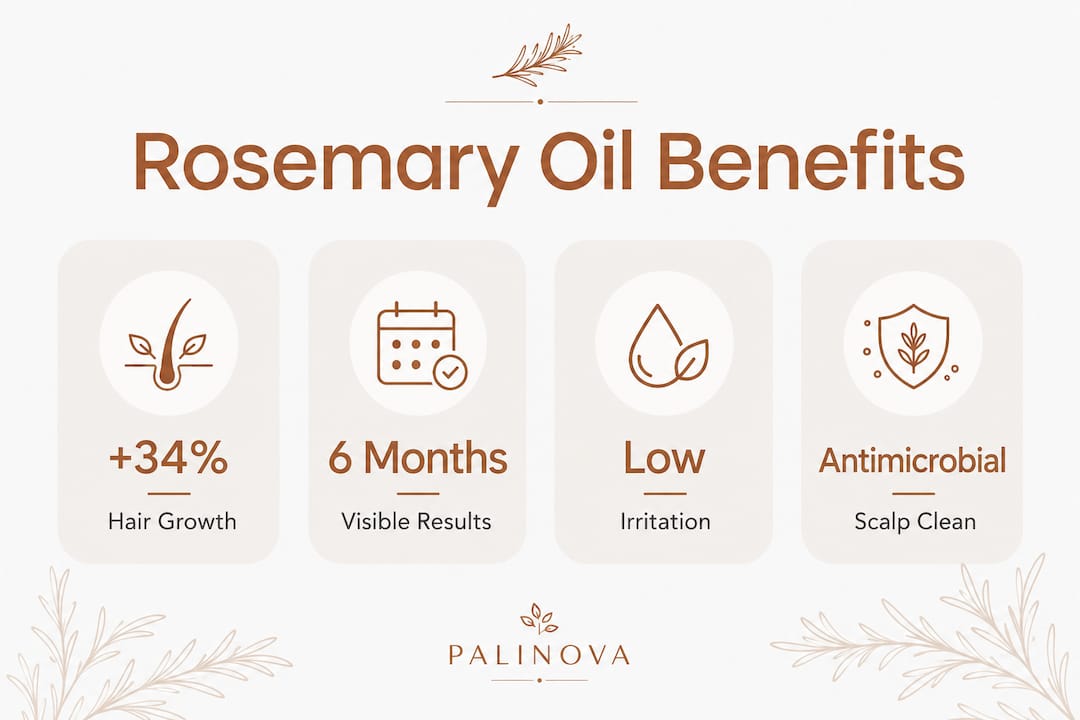
Rosemary oil for hair is defined as a plant-derived essential oil, extracted from Salvia rosmarinus, that stimulates scalp blood flow and nourishes hair follicles to support growth and reduce shedding. A 6-month randomised trial found rosemary oil increased hair count comparably to minoxidil 2%, with less scalp itching reported. Its bioactive compounds, particularly carnosic acid and rosmarinic acid, deliver antioxidant and anti-inflammatory effects that protect follicles from oxidative stress. For anyone seeking a gentle, plant-based route to thicker, healthier hair, the clinical evidence is now hard to ignore.
What are the scientifically supported benefits of rosemary oil for hair?
Rosemary oil promotes hair growth by improving scalp microcirculation and delivering nutrients directly to hair follicles. Trichologist Helen Reavey and dermatologist Dr Marnie Nussbaum both confirm that better scalp circulation prevents follicular miniaturisation, the process that causes follicles to shrink and eventually stop producing hair. That mechanism explains why clinical results are so consistent across different trial designs.

The evidence base has grown substantially. A 90-day clinical trial in 2025 involving 90 participants found that a rosemary-based oil combination improved hair growth rate, increased thickness, and reduced shedding. These are measurable outcomes, not subjective impressions.
The key bioactive compounds driving these results include:
Carnosic acid: repairs nerve and tissue damage in the scalp, supporting follicle regeneration
Rosmarinic acid: reduces scalp inflammation that can block healthy hair cycling
Ursolic acid: shown to inhibit the enzyme linked to androgenetic hair loss
1,8-cineole: a volatile compound that improves local circulation when absorbed through the skin
“Rosemary oil’s antioxidant and anti-inflammatory compounds protect the scalp environment from oxidative stress, creating conditions where follicles can function at their best. This is not a cosmetic effect. It is a physiological one.” — Phytochemical analysis, Salvia rosmarinus pharmacological review
Rosemary essential oil for hair also carries an antimicrobial action that keeps the scalp environment clean. A clean, balanced scalp reduces the chronic low-grade inflammation that silently shortens the hair growth cycle. The superior side-effect profile compared to minoxidil means people are far more likely to stick with the treatment long enough to see results. Adherence is where most natural remedies fail. Rosemary oil is an exception.
How to safely use rosemary oil for hair growth and scalp care
Safe application of rosemary oil follows a straightforward protocol, but the details matter. Dermatologist-recommended guidance specifies mixing 5 drops of rosemary essential oil with a carrier oil, massaging it into the scalp for 5–10 minutes, then rinsing thoroughly. Starting at 1–2 applications per week gives the scalp time to adjust before increasing frequency.
Follow these steps for a safe and effective rosemary oil hair treatment:
Choose your carrier oil. Jojoba, coconut, or sweet almond oil all work well. Jojoba most closely mimics the scalp’s natural sebum, making it a strong first choice for most hair types.
Dilute correctly. A 2–4% dilution is the standard safe range. That equals roughly 12–24 drops of rosemary essential oil per 30ml of carrier oil.
Patch test first. Apply a small amount to the inner forearm and wait 24 hours. Any redness or itching means the concentration is too high or the oil does not suit your skin.
Massage the scalp. Use your fingertips in small circular motions for 5–10 minutes. This step is not optional. The massage itself improves circulation independently of the oil.
Leave on or rinse. For a pre-shampoo treatment, leave the oil on for 30–60 minutes, then wash out. For a lighter approach, add 2–3 drops to your regular conditioner and leave it in.
Build frequency gradually. Start with twice a week. After four weeks with no irritation, you can increase to three or four times weekly.
Pro Tip: Add 2 drops of rosemary essential oil directly to your shampoo bottle (per 100ml of shampoo) for a low-effort daily treatment. This method suits people with fine or oily hair who cannot tolerate leave-on oils.
Avoid applying undiluted rosemary oil directly to the scalp. Undiluted application causes burning and irritation that can worsen scalp health rather than improve it. People with sensitive scalps should start at the lower end of the dilution range and increase only once tolerance is confirmed.
What tools and products enhance rosemary oil’s effectiveness?
The right supporting products make a measurable difference to how well rosemary oil performs. Carrier oils are the foundation. Each has distinct properties that affect how the treatment feels and how well it absorbs.
Carrier oil | Key benefit | Best for |
Jojoba | Mimics scalp sebum, non-greasy | All hair types, oily scalps |
Coconut | Deep conditioning, antimicrobial | Dry or damaged hair |
Sweet almond | Lightweight, rich in vitamin E | Fine hair, sensitive scalps |
Argan | High oleic acid, smoothing | Frizzy or coarse hair |
Barbary Fig Seed Oil | Rich in rare fatty acids, anti-ageing | Mature hair and scalp |
Palinova’s Barbary Fig Seed Oil is a particularly strong carrier choice. It contains a high concentration of rare fatty acids that support scalp cell renewal alongside the rosemary oil’s growth-stimulating action.
Complementary essential oils also play a role. Pairing rosemary oil with peppermint and internal nutritional support produces better outcomes than rosemary oil alone. Peppermint oil contains menthol, which creates a vasodilatory effect on scalp blood vessels. Adding 2–3 drops of peppermint to your rosemary blend amplifies the circulation benefit without adding complexity.
Scalp massage tools, specifically silicone scalp massagers, improve the mechanical stimulation during application. They distribute oil more evenly and increase the depth of the massage compared to fingertips alone. Consistency of application matters more than any single product choice. The natural hair care oil from Palinova combines several of these principles in a ready-to-use format for those who prefer a pre-blended option.
How to integrate rosemary oil into your existing hair care routine
Rosemary oil works best when it fits naturally into what you already do, rather than replacing your entire routine. The most common mistake is applying too much oil and leaving it on overnight, which leads to greasy, weighed-down hair, particularly for those with fine or oily hair types.
Practical guidelines for daily integration:
Pre-shampoo treatment: Apply the diluted oil 30–60 minutes before washing. This is the most effective method for dry or thick hair.
Post-wash scalp serum: Apply a small amount to a damp scalp after shampooing. Use sparingly to avoid residue.
Shampoo additive: Mix 2–3 drops into your shampoo at the point of use. This suits oily hair types who cannot tolerate leave-on oils.
Conditioner blend: Add 1–2 drops to your conditioner for a light, conditioning treatment without heaviness.
For dandruff or scalp irritation, apply the oil blend two to three times per week directly to affected areas. The antimicrobial and anti-inflammatory properties address the root cause rather than just the visible flaking.
Pro Tip: Set a calendar reminder for your rosemary oil applications. Consistency is the single biggest predictor of results. Missing weeks resets the cumulative benefit.
Realistic expectations matter here. Visible improvement typically appears around 6 months of consistent use, with little noticeable change in the first three months. This is not a failure of the treatment. It reflects the natural hair growth cycle, which operates on a timeline of weeks and months, not days. Anyone who stops at month two because they see nothing is abandoning the treatment just before it begins to work.
Possible side effects and how to avoid them
Rosemary oil is well tolerated by most people, but it is not risk-free when used incorrectly. The most common problems are contact dermatitis and scalp irritation, both of which are almost entirely preventable with proper dilution.
Key precautions to follow:
Always dilute to 2–4% before applying to the scalp. Never use undiluted.
Patch test on the inner forearm for 24 hours before first scalp application.
Keep the oil away from eyes and broken or inflamed skin.
Start at 1–2 applications per week and increase only after confirming tolerance.
Stop use immediately if you notice persistent redness, itching, or swelling.
Consult a dermatologist if symptoms do not resolve within 48 hours of stopping.
“The lower incidence of scalp irritation with rosemary oil is one of its most clinically significant advantages. Better tolerability translates directly into better long-term adherence, and adherence is what produces results.” — Comparative analysis, rosemary oil versus minoxidil clinical studies
People with known allergies to plants in the Lamiaceae family, which includes mint, basil, and lavender, should exercise extra caution and consult a healthcare professional before use. Pregnant or breastfeeding individuals should seek medical advice before adding any essential oil to their routine.
Key takeaways
Rosemary oil delivers clinically comparable hair growth results to minoxidil 2%, with a significantly better tolerability profile that supports consistent, long-term use.
Point | Details |
Clinical efficacy | A 6-month trial found rosemary oil matched minoxidil 2% for hair count with less scalp itching. |
Safe dilution | Always dilute to 2–4% in a carrier oil; undiluted application causes burning and irritation. |
Realistic timeline | Visible results typically appear at 6 months; expect little change in the first 3 months. |
Complementary approach | Pairing rosemary oil with peppermint and good nutrition produces better outcomes than oil alone. |
Consistency is critical | Apply 1–4 times weekly without long gaps; adherence determines whether the treatment works. |
What I have learned from years of watching people use rosemary oil
Most people approach rosemary oil the way they approach pharmaceutical treatments: they expect fast, dramatic results, and they quit when those results do not appear on schedule. That is the wrong frame entirely.
What I have observed consistently is that the people who get real, lasting results from rosemary oil share one trait. They treat it as a scalp health practice rather than a quick fix. They massage it in properly, they pair it with decent nutrition, and they do not skip weeks because life got busy. The oil itself is only part of the equation.
The low irritation profile is genuinely underrated. With minoxidil, a significant number of people stop because the scalp itching becomes intolerable. With rosemary oil, that barrier largely disappears. People keep going. And keeping going is what produces the hair growth you can actually see and measure.
I also think the obsession with finding the “best rosemary oil for hair” misses the point. Purity matters, yes. But a pure oil applied inconsistently will always underperform a decent oil applied faithfully. Spend less time researching products and more time building the habit. The science on hair loss prevention supports this view clearly.
One more thing: rosemary oil works best as part of a broader scalp care approach. Combine it with a balanced diet, adequate sleep, and reduced mechanical stress on the hair. No single ingredient fixes multifactorial hair thinning on its own. But rosemary oil is one of the most evidence-backed tools available for the job.
— Abdelmuhsen*
Natural essential oils for hair and scalp care from Palinova
Palinova sources its essential oils directly from Palestinian botanical traditions, using plants grown and harvested with care for both quality and sustainability. Every oil is free from synthetic additives, making them well suited for people who want clean, plant-based ingredients in their hair care routine.

For rosemary oil treatments, the carrier oil you choose shapes the entire experience. Palinova’s Wildcrafted Cypress Essential Oil pairs particularly well with rosemary oil blends, adding its own circulatory and toning properties to the scalp treatment. The Palinova shop also carries a range of complementary oils suited to different hair types and scalp conditions, from deeply nourishing seed oils to lighter options for fine hair. Free aromatherapy consultations are available for anyone who wants guidance on building a personalised blend.
FAQ
Does rosemary oil actually work for hair growth?
Yes. A 6-month randomised trial found rosemary oil increased hair count comparably to minoxidil 2%, with fewer side effects. A separate 2025 clinical trial also confirmed improved growth rate, thickness, and reduced shedding after 90 days.
How often should I apply rosemary oil to my scalp?
Start with 1–2 applications per week and increase to 3–4 times weekly once your scalp tolerates it well. Consistent application over several months is what produces visible results.
Can I use rosemary oil for dandruff?
Yes. Rosemary oil’s antimicrobial and anti-inflammatory properties address the scalp imbalance that causes dandruff. Apply a diluted blend to affected areas two to three times per week for best results.
How long before I see results from rosemary oil?
Visible improvement typically appears around 6 months of consistent use. Most people notice little change in the first three months, which reflects the natural hair growth cycle rather than a failure of the treatment.
Is rosemary oil safe to use undiluted on the scalp?
No. Undiluted rosemary oil causes burning and irritation and can damage scalp health. Always dilute to a 2–4% concentration in a carrier oil such as jojoba, coconut, or sweet almond oil before applying.
Recommended

Comments